Soru işareti ?
Sembol anlamı
The question mark is put at the end of the sentence to show the corresponding intonation. Ancient writers used it; However, the outline was different. In the Syrian texts, it looked like a colon and was placed at the beginning of a sentence, if it did not start with a question word. And in the Greek, it looked, approximately, as a point with a lightning gushing from right to left (·∼). The modern look, found in print from the 16th century, however, did not always express the question but was acknowledged in the 18th century. In the Spanish letter, the symbol of an ¿ is added at the beginning of the sentence. It is convenient to know in advance what intonation should be used.
The image of the question mark is associated with the Latin word “quaestio” — which means a search for an answer. Over time, for shortness, they simply began to write q over o. Then the mark mutated into what we see today.
Sometimes a question mark is used with an exclamation mark. According to the rules of Russian punctuation, it should be used as
⁈
, but not like that
 .
.
In Unicode, there are still ⸮ and ⁇ .
Other symbols are used to indicate interrogative intonation:
; Greek.
¿ Optional Spanish. It is placed at the beginning of sentences.
؟ Arab.
՞ Artsakan nshan. Armenian.
܆ Old Syrian. It was used at the beginning of the sentence if it did not start with a question word.
፧ Ethiopian.
꘏ Wai.
꛷ Bamum.
𑅃 Chakma.
꫱ Manipuri.
᥅ Limbu.
“Soru işareti” sembolü, “Temel latin” bloğunun “ASCII noktalama işaretleri” Alt bloğunda yer almakta ve Unicode versiyon 1.1 kapsamında 1993 yılında onaylanmıştır.
Bir emoji görsel stili seçin ve tam boyutta açın. Tüm görselleri indirip tasarımlarınızda ve sunumlarınızda kullanabilirsiniz.

🛈 Emoji görselleri ilgili hak sahiplerinin mülkiyetindedir. Yalnızca önizleme içindir. Lütfen her sağlayıcının lisans koşullarına uyun.
🛈 Açık lisanslı görseller. {{licence}} lisansının şartlarına göre ücretsiz indirilebilir ve kullanılabilir. Atıf gerekebilir.
| Unicode adı | Question Mark |
| Unicode numarası | |
| HTML varlığı | ? |
| Düzlem | 0: Temel çok dilli düzlem |
| Unicode bloğu | Temel latin |
| Unicode alt bloğu | ASCII noktalama işaretleri |
| Unicode sürümü | 1.1 (1993) |
| Alt kodu |
| Eşleştirilmiş ayna braketi tipi (bidi) | None |
| Kompozisyon hariç tutma | No |
| Vaka değişikliği | 003F |
| Basit durum değişikliği | 003F |
| Grapheme_Base | + |
| scripts | Common |
| Terminal_Punctuation | + |
| Sentence_Terminal | + |
| Pattern_Syntax | + |
| Kodlama | hex | dec (bytes) | dec | binary |
|---|---|---|---|---|
| UTF-8 | 3F | 63 | 63 | 00111111 |
| UTF-16BE | 00 3F | 0 63 | 63 | 00000000 00111111 |
| UTF-16LE | 3F 00 | 63 0 | 16128 | 00111111 00000000 |
| UTF-32BE | 00 00 00 3F | 0 0 0 63 | 63 | 00000000 00000000 00000000 00111111 |
| UTF-32LE | 3F 00 00 00 | 63 0 0 0 | 1056964608 | 00111111 00000000 00000000 00000000 |
Soru işareti karakterini web siteleri, sosyal medya, mesajlaşma uygulamaları veya blog gönderilerinde metin olarak kullanmak için bu kodları kopyalayıp yapıştırın.
| HTML | |
| CSS | |
| JavaScript, JSON | |
| Unix, C, PHP, JAVA | |
| Ruby, PHP | |
| Perl | |
| URL-encode |
-
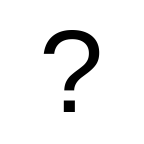 Arimo
Arimo -
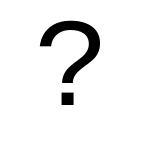 Cousine
 -
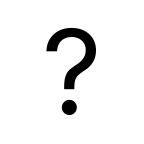 Inter
Inter -
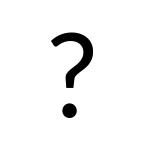 Lato
Lato -
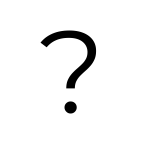 Montserrat
 -
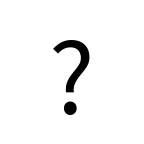 Noto Sans Jp
 -
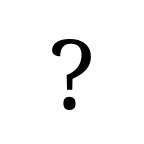 Noto Serif
 -
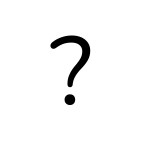 Nunito
 -
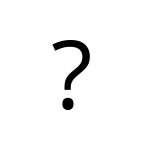 Open Sans
 -
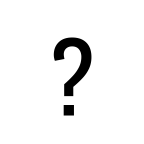 Oswald
 -
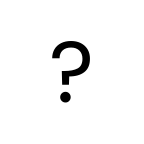 Poppins
 -
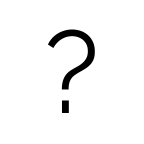 Raleway
 -
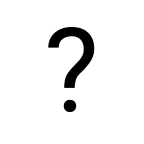 Roboto
 -
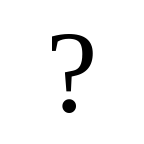 Tinos
Tinos
