
Znak zapytania ?
Znaczenie symbolu
The question mark is put at the end of the sentence to show the corresponding intonation. Ancient writers used it; However, the outline was different. In the Syrian texts, it looked like a colon and was placed at the beginning of a sentence, if it did not start with a question word. And in the Greek, it looked, approximately, as a point with a lightning gushing from right to left (·∼). The modern look, found in print from the 16th century, however, did not always express the question but was acknowledged in the 18th century. In the Spanish letter, the symbol of an ¿ is added at the beginning of the sentence. It is convenient to know in advance what intonation should be used.
The image of the question mark is associated with the Latin word „quaestio” — which means a search for an answer. Over time, for shortness, they simply began to write q over o. Then the mark mutated into what we see today.
Sometimes a question mark is used with an exclamation mark. According to the rules of Russian punctuation, it should be used as
⁈
, but not like that
 .
.
In Unicode, there are still ⸮ and ⁇ .
Other symbols are used to indicate interrogative intonation:
; Greek.
¿ Optional Spanish. It is placed at the beginning of sentences.
؟ Arab.
՞ Artsakan nshan. Armenian.
܆ Old Syrian. It was used at the beginning of the sentence if it did not start with a question word.
፧ Ethiopian.
꘏ Wai.
꛷ Bamum.
𑅃 Chakma.
꫱ Manipuri.
᥅ Limbu.
Symbol „Znak zapytania” jest zawarty w podbloku „Interpunkcja ASCII” bloku „Podstawowy łaciński” i został zatwierdzony jako część wersji Unicode 1.1 w 1993 roku.
Wybierz styl obrazu emoji i otwórz go w pełnym rozmiarze. Wszystkie obrazy można pobrać i używać w swoich projektach i prezentacjach.

🛈 Obrazy emoji są własnością odpowiednich właścicieli praw. Tylko do podglądu. Zawsze przestrzegaj warunków licencji każdego dostawcy.
🛈 Obrazy na otwartej licencji. Bezpłatne pobieranie i używanie zgodnie z warunkami licencji {{licence}}. Może być wymagane podanie autorstwa.
| Nazwa Unicode | Question Mark |
| Numer Unicode | |
| Encja HTML | ? |
| Płaszczyzna | 0: Główna płaszczyzna wielojęzyczna |
| Blok Unicode | Podstawowy łaciński |
| Podblok Unicode | Interpunkcja ASCII |
| Wersja Unicode | 1.1 (1993) |
| Kod Alt |
| Typ sparowanego wspornika lusterka (bidi) | None |
| Wykluczenie kompozycji | No |
| Zmiana przypadku | 003F |
| Prosta zmiana obudowy | 003F |
| Grapheme_Base | + |
| scripts | Common |
| Terminal_Punctuation | + |
| Sentence_Terminal | + |
| Pattern_Syntax | + |
| Kodowanie | hex | dec (bytes) | dec | binary |
|---|---|---|---|---|
| UTF-8 | 3F | 63 | 63 | 00111111 |
| UTF-16BE | 00 3F | 0 63 | 63 | 00000000 00111111 |
| UTF-16LE | 3F 00 | 63 0 | 16128 | 00111111 00000000 |
| UTF-32BE | 00 00 00 3F | 0 0 0 63 | 63 | 00000000 00000000 00000000 00111111 |
| UTF-32LE | 3F 00 00 00 | 63 0 0 0 | 1056964608 | 00111111 00000000 00000000 00000000 |
Skopiuj i wklej te kody, aby użyć postaci Znak zapytania w tekście na stronach internetowych, w mediach społecznościowych, komunikatorach lub wpisach na blogu.
| HTML | |
| CSS | |
| JavaScript, JSON | |
| Unix, C, PHP, JAVA | |
| Ruby, PHP | |
| Perl | |
| URL-encode |
-
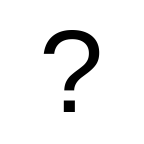 Arimo
Arimo -
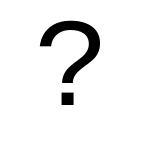 Cousine
 -
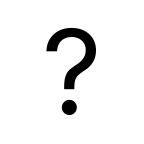 Inter
Inter -
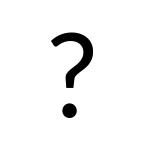 Lato
Lato -
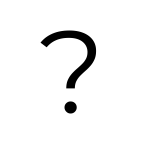 Montserrat
 -
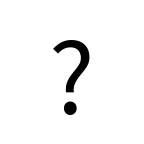 Noto Sans Jp
 -
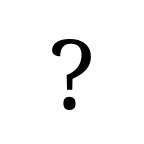 Noto Serif
 -
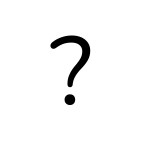 Nunito
 -
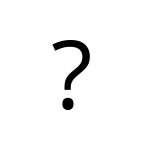 Open Sans
 -
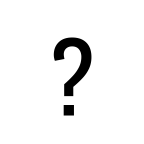 Oswald
 -
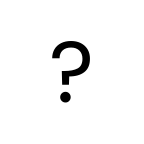 Poppins
 -
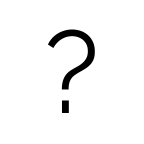 Raleway
 -
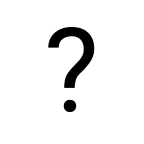 Roboto
 -
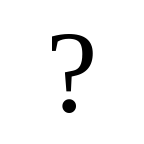 Tinos
Tinos
